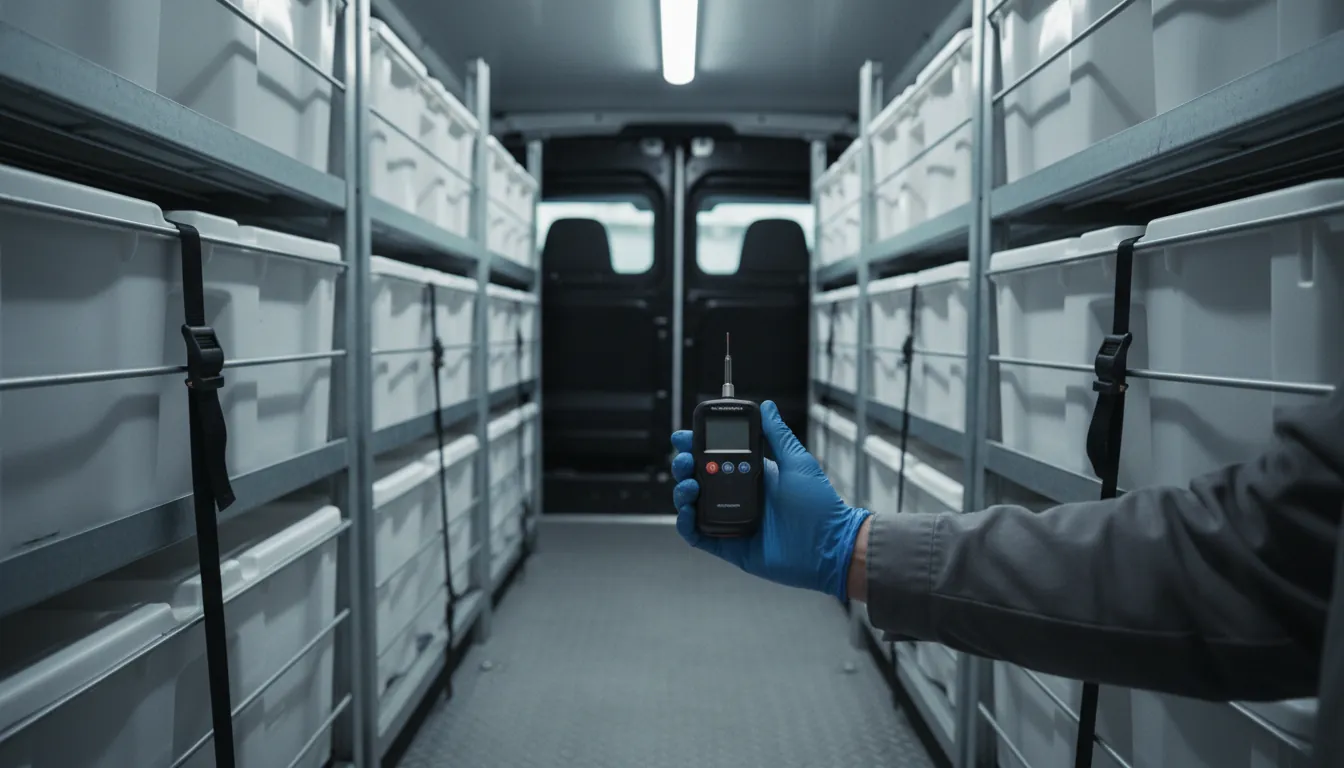
Where GDP comes from in Great Britain
Good Distribution Practice (GDP) sets the standards for moving and storing medicines between the manufacturer and the pharmacy, hospital or other customer. In Great Britain the legal basis is the Human Medicines Regulations 2012. Under regulation C17, the EU Guidelines on Good Distribution Practice of Medicinal Products for Human Use (2013/C 343/01), as they applied immediately before the end of the Brexit transition period, continue to apply in Great Britain unless the MHRA publishes replacements. It has not published a separate UK version. The MHRA's own GDP guidance points to these guidelines, and its Rules and Guidance for Pharmaceutical Distributors (the "Green Guide") brings the material together.
This guide covers Great Britain. Northern Ireland has different arrangements for medicines under the Windsor Framework, so check them separately if you deliver there.
How GDP reaches the carrier
GDP duties sit first with the wholesale distributor, usually the holder of a wholesale dealer's licence, known as a WDA(H). Chapter 9 of the guidelines makes the supplying wholesaler responsible for protecting medicines against breakage, adulteration and theft, and for keeping temperature conditions within acceptable limits during transport. That responsibility does not go away when the wholesaler hires a haulier or courier.
Chapter 7 deals with outsourced activities. The wholesaler, as "contract giver", must assess your competence before work starts, set out GDP responsibilities in a written contract and audit you, with the frequency based on risk. You, as "contract acceptor", must have adequate premises, equipment, procedures, knowledge, experience and competent staff. You must not pass any of the work to a third party without the contract giver's prior evaluation and approval. In short: if you carry medicines, you carry GDP obligations through your contract, and your client will check that you meet them.
Quality Agreements
The written contract the guidelines require is usually called a Quality Agreement or Technical Agreement. Put it in place before you carry the first consignment. A good one covers:
- the scope of work: product types, temperature ranges, routes, collection and delivery points
- who is responsible for what, including temperature monitoring and data review
- how and when you report deviations such as temperature excursions, damage, delays and security incidents
- subcontracting rules, including the need for prior approval
- vehicle and equipment qualification, calibration and maintenance
- training requirements for drivers and staff
- security arrangements, returns and handling of rejected goods
- the client's right to audit you, and how changes to the service are agreed
Read the agreement as a list of things you will be audited against. If you cannot evidence a clause, either fix the gap or change the clause before you sign.
Temperature control: work to the label, not a rule of thumb
GDP does not set one temperature range for "ambient" medicines. The guidelines require the storage conditions for each product to be maintained during transport within the limits set by the manufacturer or shown on the outer packaging. In practice the common conditions are 15–25°C or "do not store above 25°C" for ambient products, 2–8°C for refrigerated products, and the stated range for frozen products. Your Quality Agreement should state the conditions for each product you carry.
The guidelines then expect you to:
- use a risk assessment of delivery routes to decide where temperature control is needed
- use qualified equipment, such as thermal packaging, temperature-controlled containers or refrigerated vehicles, for temperature-sensitive products
- carry out temperature mapping of temperature-controlled vehicles under representative conditions, taking seasonal variation into account
- maintain and calibrate temperature monitoring equipment in vehicles and containers at regular intervals, at least once a year
- place cool-packs so they do not touch the product, and train staff to assemble insulated boxes and handle reused cool-packs correctly
- be able to show customers evidence that products stayed within their storage conditions
- pay particular attention to temperature monitoring where goods are unloaded and reloaded at a transit hub
Most GDP problems in transport are temperature problems, and most of those come from gaps in evidence rather than real excursions. A logger that was not calibrated, a mapping study that only covered winter, or data nobody reviewed will all count against you at audit.
Vehicles, cleaning and security
Keep written procedures for operating and maintaining every vehicle and piece of equipment used to carry medicines, including cleaning and safety precautions. Use dedicated vehicles and equipment where possible. Where you use non-dedicated vehicles, you need procedures that make sure the quality of the medicines is not compromised, for example by cleaning and segregation from other loads.
Deliver to the address on the delivery note, into the care or premises of the consignee. Do not leave medicines at alternative premises. Have written procedures and named contacts for emergency and out-of-hours deliveries. Security procedures should cover loading, parking, keys, documentation and what drivers do if a vehicle is broken into. Controlled drugs carry extra requirements under the Misuse of Drugs Regulations 2001, and dangerous goods remain subject to ADR.
Deviation management
If a temperature excursion or product damage happens in transit, the guidelines require it to be reported to the distributor and the recipient of the affected medicines. Report quickly and do not decide for yourself that a product is fine. Behind that you need a deviation system that records the event, investigates the root cause, sets corrective and preventive actions, and checks that they worked. Clients and inspectors read deviation records closely, and a log with no entries for a busy temperature-controlled fleet is itself a warning sign.
Driver and staff training
Everyone involved in carrying medicines needs GDP training suited to their role: what GDP is and why it matters, temperature monitoring, packing and loading, security, documentation, deviation reporting and what to do in a breakdown. Record the training, refresh it, and make sure agency or subcontracted drivers receive it before they handle medicines.
Falsified Medicines Directive: what changed
Some older guidance still tells carriers they must comply with the Falsified Medicines Directive. The FMD safety features, a unique identifier on each pack checked against a verification system, stopped applying in Great Britain on 1 January 2021. Under the Windsor Framework they also stopped applying in Northern Ireland from 1 January 2025, when medicines for the UK market started to carry "UK Only" labelling. Carriers were never the party that scanned packs. Your role is to keep packaging intact, report damage or signs of tampering as a deviation, and keep the documentation trail complete.
Client audits and MHRA inspections
The MHRA inspects wholesale dealer licence holders. Because the wholesaler remains responsible for outsourced transport, the way it selects, contracts and audits its carriers is part of that inspection. A weakness found in your operation becomes a finding against your client, and the usual response is to suspend or end the carrier arrangement until it is fixed. Most carriers meet GDP through client audits rather than through the MHRA directly. Treat each client audit as preparation for the inspection your client will face.
Common gaps we find
| Gap | What the auditor expects |
|---|---|
| No signed Quality Agreement, or one that does not match the work | A current agreement that reflects the products, routes and temperature ranges you actually carry |
| Temperature mapping done once, in one season | Mapping under representative conditions, including seasonal variation, repeated when the vehicle or its temperature control equipment changes significantly |
| Loggers out of calibration | Calibration at least once a year, with certificates on file |
| Excursions closed without investigation | Reported to the distributor and recipient, investigated, with corrective action checked |
| Subcontractors used without approval | Prior evaluation and approval by the contract giver, recorded |
| Training not recorded for agency drivers | Role-specific GDP training records for everyone who handles medicines |
How J&JL helps
We build audit-ready GDP systems for pharmaceutical carriers: a GDP quality manual, standard operating procedures, Quality Agreement drafting, vehicle and equipment qualification records, temperature monitoring and calibration procedures, deviation management, and driver training records. We then audit the system as your client would. Many pharmaceutical clients also ask for ISO 9001, and we can build it to the new ISO 9001:2026 edition alongside your GDP system. See our pharmaceutical transport compliance service for the full scope.
Sources and further reading
- Human Medicines Regulations 2012, regulation C17 (legislation.gov.uk)
- Guidelines on Good Distribution Practice of medicinal products for human use, 2013/C 343/01 (EUR-Lex)
- Good manufacturing practice and good distribution practice (MHRA, GOV.UK)
- Windsor Framework: supply of medicines in Northern Ireland explained (GOV.UK)
- Understanding the Falsified Medicines Directive (SPS, NHS)
Checked against the sources above on 5 October 2026.