What the law requires of a medicines carrier
Wholesale distribution of medicines in the UK is governed by the Human Medicines Regulations 2012. Anyone who supplies medicines to other businesses needs a wholesale dealer's licence for human medicines, the WDA(H), and must follow the Guidelines on Good Distribution Practice.
In Great Britain those guidelines are still the EU GDP Guidelines of 5 November 2013 (2013/C 343/01). Regulation C17 of the Human Medicines Regulations 2012 says they continue to apply, as they stood immediately before the end of the Brexit transition period, unless the MHRA publishes replacements. As of October 2026 it has not. There is no separate set of "UK GDP guidelines". The MHRA's own guidance on good distribution practice still points to the EU text, and its Rules and Guidance for Pharmaceutical Distributors (the "Green Guide") brings the material together in one place.
Two chapters of the guidelines matter most to a carrier:
- Chapter 7, outsourced activities. The licence holder (the contract giver) stays responsible for anything it outsources. The carrier (the contract acceptor) must have suitable equipment, procedures, knowledge and competent staff, must accept audits, and must not pass work to a subcontractor without the contract giver's prior evaluation and approval.
- Chapter 9, transportation. Medicines must reach the customer without being exposed to conditions that could affect their quality. Transport must be planned on a risk basis, storage conditions kept within defined limits, deviations reported, and temperature monitoring equipment maintained and calibrated.
So GDP is not optional for a carrier. You are not the licence holder, but your client cannot meet its own legal obligations unless you meet yours, and it will check.
Who is responsible for what
Most disputes and most audit findings come from blurred responsibilities. This is how the split normally works. Your Quality Agreement should confirm it for each client.
| Area | WDA(H) holder (your client) | Carrier (you) |
|---|---|---|
| Overall product quality | Responsible in law and holds the licence | Protects quality while goods are in your care |
| Transport conditions | Defines the storage conditions for each product | Keeps products within those limits and proves it with records |
| Carrier approval | Qualifies, audits and monitors you | Gives access, evidence and prompt answers |
| Deviations | Decides on the fate of affected stock | Reports excursions and damage straight away, then investigates |
| Subcontracting | Must approve any subcontractor first | Never hands loads on without written approval |
| Vehicles and equipment | Specifies requirements | Qualifies, maintains and calibrates them |
If you store, cross-dock or hold stock overnight outside of transit, raise it with your client and the MHRA before you do it. Storage brings its own requirements, and the guidelines expect any time limit for goods held at a transport hub to be defined in advance.
The Quality Agreement
The Quality Agreement is the written contract that turns Chapter 7 into practice. Do not carry medicines for a licence holder without one. A good agreement sets out:
- the products and temperature categories you are approved to carry;
- the vehicles, packaging and routes covered, and how they are qualified;
- who monitors temperature, with what equipment, and how data is shared;
- how and how quickly deviations, excursions, damage and security incidents are reported;
- the rules on subcontracting, hubs and overnight holds;
- audit rights, change notification and record retention;
- named contacts on both sides, including the client's Responsible Person.
We draft agreements that your SOPs can actually deliver. A common failure is signing a client's template that promises things your operation does not do, such as continuous remote monitoring on every vehicle. Auditors test the agreement against what happens on the road.
Temperature control: the label sets the limit
GDP does not set one temperature range for "ambient" medicines. It requires each product to be kept within the storage conditions on its label or marketing authorisation throughout transport. Common label conditions are 15–25°C or "do not store above 25°C" for ambient products, 2–8°C for refrigerated products, and a specified range for frozen products. Your vehicles and packaging must be shown to keep products within whichever limits apply to the load.
For temperature-controlled transport, the guidelines and auditors expect:
- qualified equipment: thermal packaging, temperature-controlled containers or vehicles;
- temperature mapping of refrigerated vehicles under representative conditions, including seasonal variation;
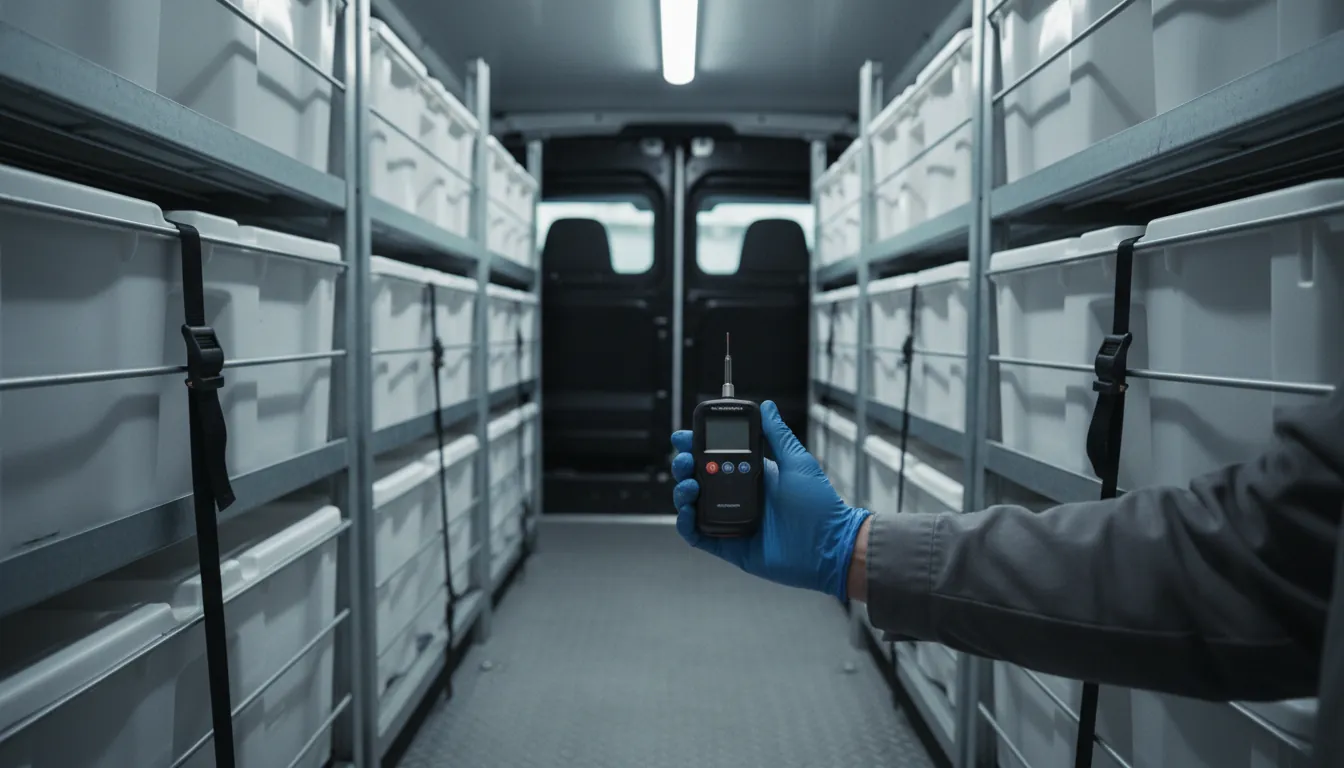
- monitoring equipment maintained and calibrated at regular intervals, at least once a year, with certificates traceable to the device in the vehicle;
- a written procedure for investigating and handling temperature excursions;
- deviations reported to the distributor and to the recipient.
Mixed loads need particular care. A 2–8°C tote in an ambient vehicle relies entirely on validated packaging and pack-out times, so the driver must know the limits and what to do when a delivery is delayed.
Vehicle and lane qualification
Qualification proves that a vehicle, or a packaging system on a given route, keeps products within limits under real conditions. We usually work in three parts:
- Installation and operational qualification. The body, refrigeration unit, alarms and data loggers are what you think they are, work as specified, and are calibrated.
- Temperature mapping. Loggers placed through the load space show hot and cold spots, recovery after door openings and performance in summer and winter. Results set the safe loading zones.
- Lane risk assessment. Each route is assessed for duration, dwell times, multi-drop door openings, hubs, ferry crossings and extreme weather, with controls for each risk.
Requalify after significant changes: a new refrigeration unit, a body repair, a new route profile or a change of packaging. Where vehicles also carry non-medicinal goods, the guidelines require procedures to make sure product quality is not compromised.
Security, delivery and records
Medicines are a theft target, and falsified medicines enter the supply chain through weak links. Your procedures should cover secure parking and unattended-vehicle rules, seal control, driver vetting, and what happens when a delivery cannot be made. Deliveries must go directly to the address on the delivery note and into the care of the consignee. Controlled drugs bring extra requirements under the Misuse of Drugs Regulations 2001, and dangerous goods may also fall under ADR.
Each consignment should travel with documentation showing the date, product and pharmaceutical form, batch number, quantity, supplier, consignee and the transport and storage conditions. Returns need their own procedure, because returned stock can only go back into saleable stock if the licence holder can show it stayed within conditions.
Deviations, CAPA and change control
Every excursion, damaged pack, security incident or missed procedure goes through a formal deviation process: record it, contain it, tell the client, find the root cause, put corrective and preventive actions (CAPA) in place and check they worked. Client auditors read deviation logs closely. A log with no entries usually means problems are not being recorded, not that none happened.
Change control matters just as much. New vehicles, subcontractors, depots, software or monitoring systems should be assessed for GDP impact before they go live.
What carriers get wrong
- Writing 15–25°C into every procedure, when some products carry different label conditions.
- Calibration certificates that do not match the serial numbers of the loggers actually fitted.
- Mapping done once, in one season, on one vehicle, then applied to the whole fleet.
- Subcontracting busy days to another haulier without the client's approval.
- Drivers who have never been trained on what an excursion looks like or who to call.
- Quality Agreements that reference "UK GDP guidelines" that do not exist, instead of the Human Medicines Regulations 2012 and the GDP Guidelines as they apply in Great Britain.
- Out-of-date claims about Falsified Medicines Directive serialisation checks (see below).
What has changed recently
- Northern Ireland, 1 January 2025. Under the Windsor Framework, the Falsified Medicines Directive safety features (the unique identifier and verification) stopped applying in Northern Ireland, and medicines for the UK market now carry "UK Only" labelling. In Great Britain those safety features stopped applying on 1 January 2021. Carriers have no serialisation scanning duty in either case.
- GDP guidelines. As of October 2026, the MHRA has not issued its own replacement for the EU GDP Guidelines, so the 2013 text continues to apply in Great Britain under regulation C17. We monitor this and update clients' documents if that changes.
- ISO 9001:2026. Published on 16 September 2026. Many pharmaceutical clients ask carriers for ISO 9001 as well as GDP. Existing ISO 9001:2015 certificates remain valid until 30 September 2029, and new certifications must be to the 2026 edition from 31 March 2028. See our ISO 9001 page.
What J&JL delivers
We build a complete, audit-ready GDP system around your vehicles, routes and clients:
- a GDP Quality Manual setting out your quality system and responsibilities;
- a full SOP suite: transport planning, loading, temperature monitoring, excursions, deviations and CAPA, security, returns, cleaning, change control, training and self-inspection;
- Quality Agreement drafting or review for each client;
- vehicle qualification protocols and reports, and lane risk assessments;
- a temperature monitoring and calibration system with records that tie to each device;
- supplier and subcontractor qualification procedures;
- driver and staff GDP training, with records;
- a mock audit against GDP Chapters 7 and 9 and your client's own questionnaire, followed by a management review.
We have done this before under deadline. One North West cold chain carrier with 12 vehicles had no GDP documentation when a new pharmaceutical client made GDP and ISO 9001 a condition of its contract. Its GDP documentation was approved by the client's quality team in month four. You can read the full account in our case studies.
Process and timescale
Timescale depends on where you start, how many vehicle types and routes need qualifying, and the season, since mapping should cover summer and winter. A carrier starting from nothing should plan in months, not weeks. We agree a dated plan at the start, built backwards from your client's deadline, and tell you straight away if a date is not realistic. If a client audit is already booked, tell us at the first call and we will prioritise what the auditor will test first.
Sources and further reading
- Human Medicines Regulations 2012, regulation C17 (legislation.gov.uk)
- Guidelines on Good Distribution Practice of medicinal products for human use, 2013/C 343/01 (EUR-Lex)
- Good manufacturing practice and good distribution practice (MHRA, GOV.UK)
- Windsor Framework: summary and FAQs (Department of Health NI)
- Understanding the Falsified Medicines Directive (SPS, NHS)
- ISO 9001:2026 published (ISO)
Checked against the sources above on 5 October 2026.