Tail lift training is a legal duty
A tail lift is work equipment under the Provision and Use of Work Equipment Regulations 1998 (PUWER) and lifting equipment under the Lifting Operations and Lifting Equipment Regulations 1998 (LOLER). Anyone who operates one at work must be trained to do it safely. That duty comes from several places:
- PUWER regulation 9: everyone who uses work equipment, and anyone who supervises or manages its use, must have received adequate training, including in the risks and the precautions to take.
- Health and Safety at Work etc. Act 1974, section 2(2)(c): the employer's duty to provide information, instruction, training and supervision.
- Management of Health and Safety at Work Regulations 1999: training when people start and when risks change (regulation 13). Agency and temporary workers must also be given suitable information (regulation 15), and section 3 of the 1974 Act covers people who are not your employees but are affected by your work.
- LOLER regulation 8: every lifting operation must be properly planned by a competent person, appropriately supervised and carried out safely.
- Manual Handling Operations Regulations 1992 and Work at Height Regulations 2005: pushing pallet trucks on and off a platform is manual handling, and a raised platform at vehicle bed height (often 1.0 to 1.5 metres) is work at height. The regulations set no minimum height.
A driver who has used tail lifts for years is not automatically trained. If you cannot show what training they received, on which lift type and when, you cannot show the duty was met.
Why it matters
Tail lift incidents tend to be serious: loads falling from the platform, pallet trucks running off the edge, feet trapped under the platform, and people falling from height. In November 2016 HGV driver Petru Pop was killed in High Wycombe when a pallet of tiles weighing about 1.5 tonnes fell from a tail lift during a delivery. His employer, Reason Transport UK, pleaded guilty to health and safety offences.
Most of the risks are controlled by a few habits: checking the lift before use, knowing the safe working load and load centre, positioning the pallet truck and load correctly, never standing in the path of a load, and knowing when to refuse a delivery. Training builds those habits and gives you the records to prove it.
LOLER thorough examination: what operators must understand
Training covers the operator. The lift itself must also be thoroughly examined by a competent person. Under LOLER regulation 9 the intervals are:
| Situation | Thorough examination |
|---|---|
| Lifting equipment used to lift people, which includes tail lifts where the operator rides the platform, and passenger or wheelchair lifts | At least every 6 months |
| Lifting equipment that only lifts goods, with nobody riding the platform | At least every 12 months |
| Either case, where a competent person has drawn up a written examination scheme | At the intervals set in the scheme |
HSE's operational guidance for tail lifts (SIM 05/2009/01) says a tail lift must be thoroughly examined by a competent person every six months, or to timing set by an examination scheme. Because most drivers ride the platform during deliveries, six months is the safe default unless a competent person's written scheme sets a different interval. A lift also needs a thorough examination after anything that could affect its safety, such as damage or major repair.
Three points operators often get wrong:
- Independence. The competent person must be sufficiently independent and impartial to make objective decisions, and should not be the same person who does the routine maintenance. The law does not require them to work for a different company.
- Record retention. Keep each report of a periodic thorough examination until the next report is made, or for two years, whichever is later (LOLER regulation 11). FORS separately expects tail lift examination reports to appear in the 15-month maintenance history it checks under V1, which is an accreditation evidence window rather than the legal rule.
- Who enforces. LOLER is enforced by HSE or the local authority, not the Traffic Commissioner. DVSA examiners and FORS auditors will still ask to see the reports as part of your maintenance evidence.
Our training makes sure every operator understands the examination system, knows where the current report is and knows to take a lift out of use when a defect is found. If you need the examination scheduling and records set up as well, our transport health and safety service covers it.
What operator training covers
We train at your operating centre, on your vehicles and lifts, so drivers practise on the equipment they actually use. Courses are certificated and every attendee's training is recorded.
Pre-use checks
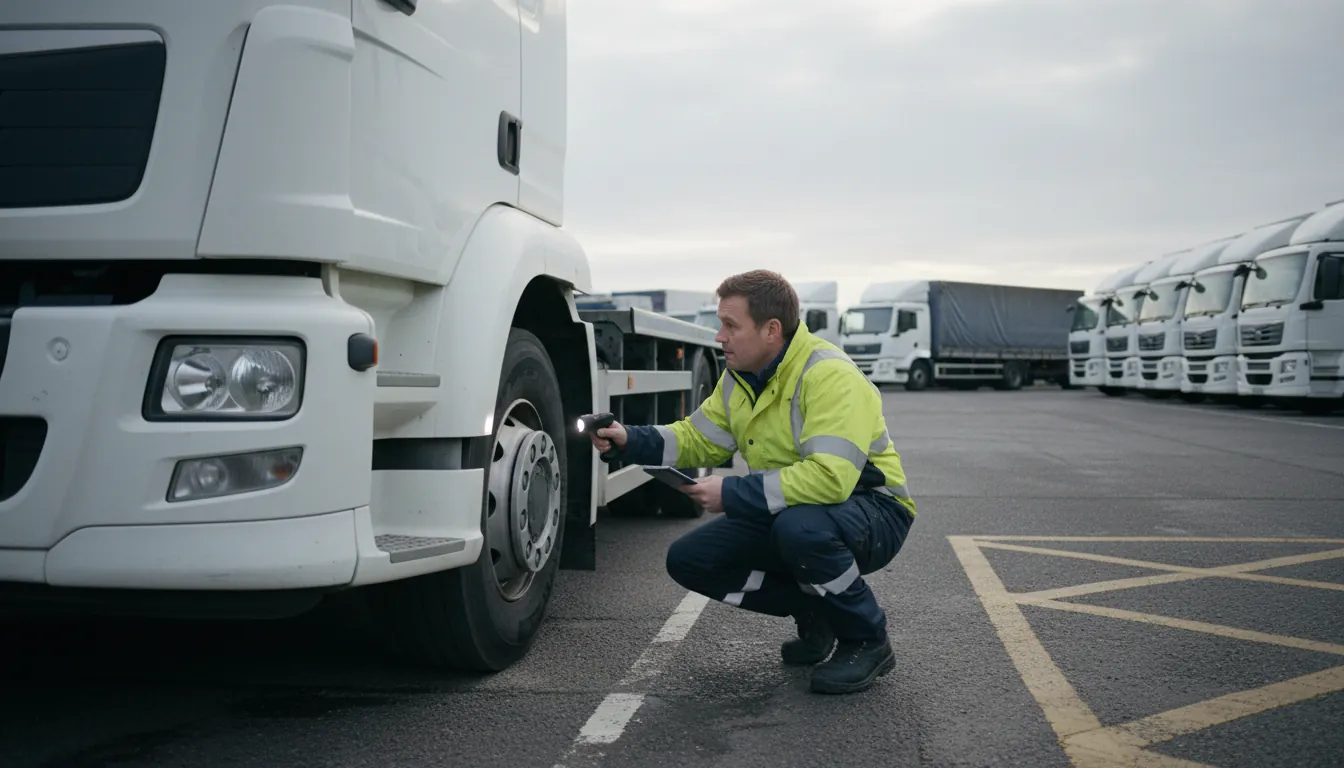
Platform condition and slip resistance, hydraulics and electrics, the safe working load plate, bolts and pins, anti-trap devices and toe guards, roll-off stops, warning lights and flags, the emergency lowering system and reflective markings. Drivers learn a quick, repeatable routine and what counts as a defect that stops the lift being used.
Safe loading and unloading
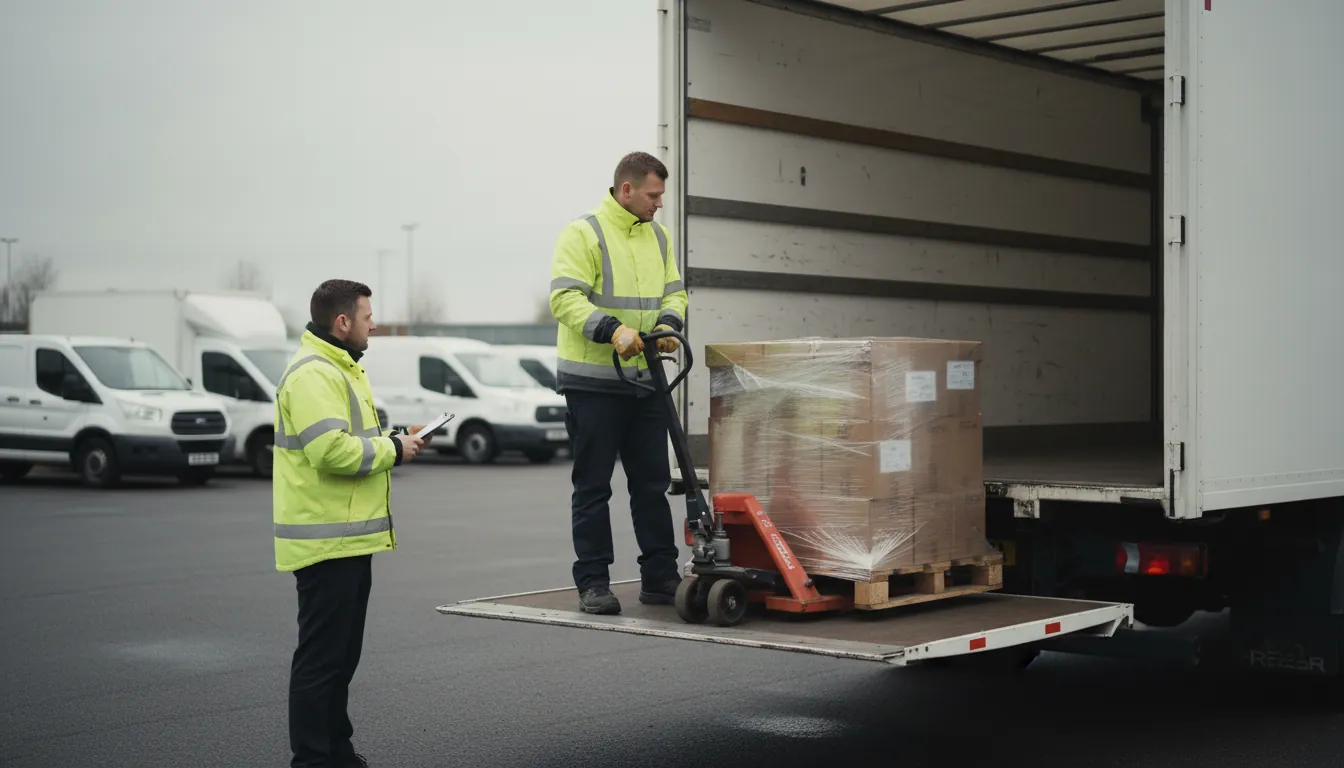
Safe working load and load centre, total weight including the pallet truck and operator, load positioning, control operation, ground and gradient assessment, weather, working at night, keeping pedestrians clear, and when and how to refuse an unsafe delivery.
Pallet trucks on the platform
Positioning before boarding, weight distribution, keeping wheels clear of the platform edge, preventing roll-off, transitioning between platform and ground, and the different risks of manual and powered pallet trucks.
Lift types
Cantilever lifts, the most common type, with their own risks at the platform heel. Tuck-away lifts, which need manual deployment and bring handling and pinch-point risks. Slider lifts, with rail mechanisms and a fixed orientation. Column lifts, which need level ground and, in two-tier versions, add working height. Passenger and wheelchair lifts, which lift people and so fall under the six-month examination interval unless an examination scheme sets otherwise.
Emergency procedures
Emergency stops on each lift type, manual emergency lowering, what to do if the platform fails or hydraulics leak, and how to report incidents and near misses.
Train the Trainer
Train the Trainer gives nominated people in your business the knowledge, instructional skills and assessment methods to train their own colleagues. It suits larger fleets, multi-site operators and businesses with regular driver turnover, because new starters can be trained on their first day without waiting for an external course.
The programme covers:
- The law: LOLER, PUWER, the Health and Safety at Work etc. Act 1974, manual handling and work at height.
- Practical competence on every lift type in your fleet.
- Tail lift risk assessment.
- Planning, delivering and evaluating a training session.
- Assessing competence through theory questions and practical assessment.
- Keeping the training records that show PUWER regulation 9 has been met.
Trainers who complete the programme receive a J&JL certificate as in-house trainers, with materials they can use for their own sessions. In one of our case studies, we trained four depot managers as in-house trainers and trained more than 60 drivers across three sites within 28 days, after a client's health and safety team asked for evidence within 30.
Refresher training
No regulation sets a fixed refresher interval. We recommend refresher training at least every three years, and sooner after any tail lift incident or near miss, a change to a different lift type, a long absence or any unsafe practice you have seen. Record the reason as well as the date.
Tail lift training and Driver CPC
Tail lift training is a legal duty under PUWER in its own right, whether or not it counts towards Driver CPC. Professional drivers need 35 hours of periodic training every five years, and only courses approved by JAUPT (on DVSA's behalf) and delivered by an approved centre count. Since December 2024, drivers who only drive in the UK can use National Driver CPC courses, which can be as short as 3.5 hours. Our tail lift training can count towards your drivers' Driver CPC periodic training hours when it is delivered as approved periodic training. Tell us when you book and we will set the course up that way and make sure the hours are recorded. Whoever you use, check a course is JAUPT-approved before you count it towards a driver's 35 hours.
Where operators go wrong
- Assuming experienced drivers or agency drivers have been trained by someone else, with nothing on file to prove it.
- Training on one lift type and then sending the driver out on a different one.
- Booking 12-monthly examinations for lifts that drivers ride every day.
- Letting the person who services the lift also sign off its thorough examination.
- Throwing away last year's examination report as soon as the new one arrives, before it is two years old.
What has changed recently
- National Driver CPC (from December 2024): shorter UK-only courses and up to 12 hours of e-learning, which changes how operators plan training days.
- DVSA Guide to Maintaining Roadworthiness (latest update April 2025): every safety inspection now includes a laden brake performance assessment. Many operators have tail lifts checked at the same visit, so it is a good time to confirm LOLER examinations are on the right interval too.
- FORS Standard v7.2 (audits from 1 September 2026): tail lift examination records remain part of V1 Serviceability and roadworthiness.
- BS EN 1756-1:2021 is the current British Standard for tail lifts for goods. It sets design and manufacture safety requirements and is a useful check when specifying new vehicles. It is not an in-service standard for operators.
Sources and further reading
- LOLER 1998, regulation 9 (thorough examination)
- LOLER 1998, regulation 11 (records)
- HSE SIM 05/2009/01: tail lifts
- HSE: thorough examination of lifting equipment
- PUWER 1998, regulation 9 (training)
- GOV.UK: Driver CPC periodic training
- Motor Transport: Reason Transport prosecution
Checked against the sources above on 5 October 2026.