What changed
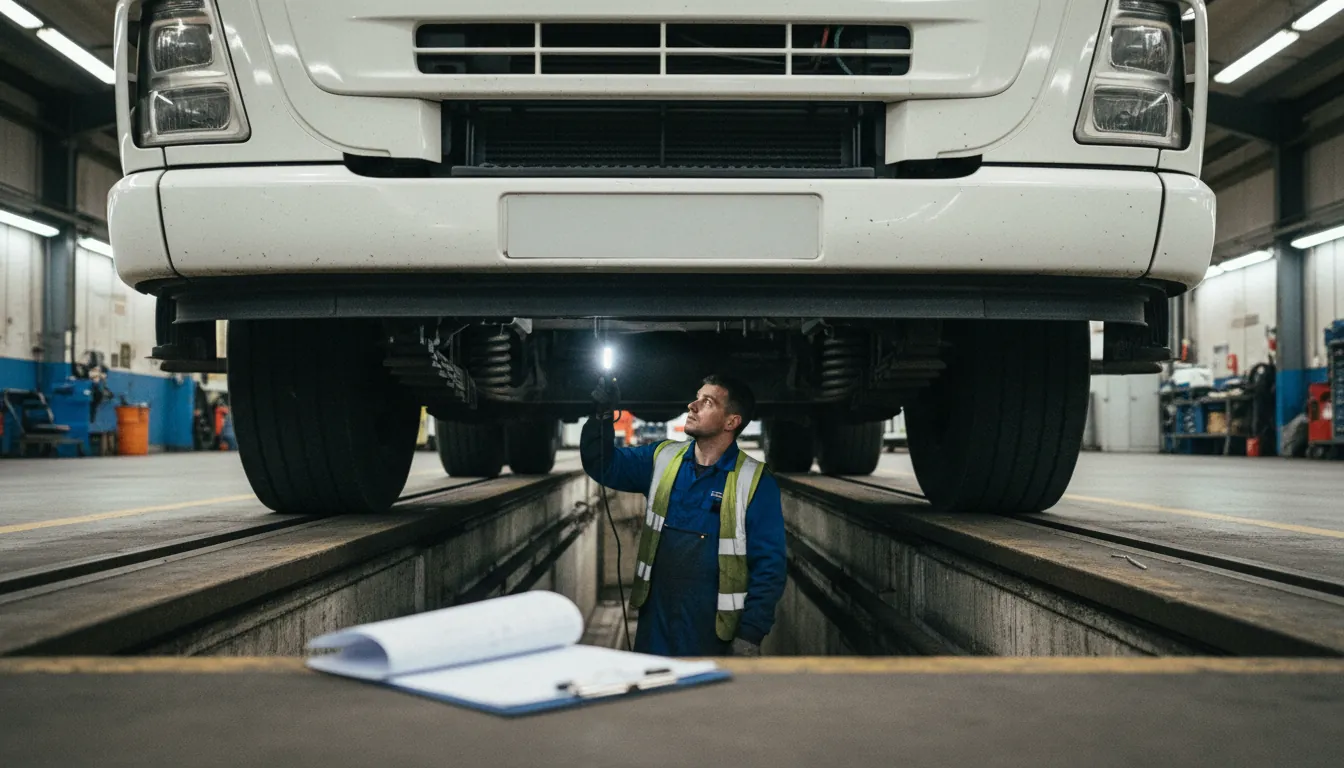
DVSA's Guide to Maintaining Roadworthiness is the benchmark DVSA examiners use when they look at an operator's maintenance system. The major revision was published in November 2024 and the current version was updated on 28 April 2025. Its biggest practical change is brake testing. In DVSA's words: "From April 2025, there will be an expectation that every safety inspection will include a laden brake performance assessment."
Before this, many operators relied on the annual test and an occasional roller brake test, often unladen, to show their brakes worked. That is no longer enough. Every safety inspection, sometimes called a PMI, now needs a brake performance assessment, and DVSA expects that assessment to be laden wherever possible.
The three accepted methods
The guide says every safety inspection will include a brake performance assessment using one of three methods.
Roller brake test (RBT)
DVSA describes a laden brake test on a calibrated roller brake tester as "the most effective method of measuring individual and overall braking performances". It measures each wheel, so it shows imbalance and binding that other methods miss. "Every attempt must be made" to carry out a laden roller brake test. To make that practical, a vehicle can be presented for a roller brake test up to 14 days before the safety inspection date, so you can test it loaded during normal work rather than loading it specially. A signed printout of the brake test should be attached to the safety inspection record.
Electronic braking performance monitoring system (EBPMS)
Some trailers are fitted with EBPMS, which monitors braking performance during normal use. A competent person must evaluate the EBPMS report before each safety inspection, and the evaluation must be signed and dated. A trailer fitted with EBPMS only needs a laden brake test if there is not enough data to produce a report. EBPMS applies to trailers, not to motor vehicles.
Decelerometer
An approved and calibrated decelerometer measures overall braking performance on a road test. It cannot identify a problem at an individual wheel. Where a decelerometer is used, the guide expects temperature readings, with brake temperatures checked before and after the test to confirm that every brake is working.
At least four laden tests a year
Where EBPMS is not used, DVSA expects "a minimum of four laden brake tests spread evenly across the year". The annual test can count as one of the four. Spread them out: four tests in the same quarter do not show that the brakes performed all year.
The four-test figure is a minimum, not the target. The expectation is still a brake performance assessment at every safety inspection, laden wherever possible, with a recorded risk assessment wherever it is not. On a six-week inspection interval, that means eight or nine inspections a year, each with a brake assessment.
When a laden test is not possible
DVSA accepts that some vehicles cannot practically be tested laden. The guide lists the acceptable reasons:
- Unladen tri-axle semi-trailers (ULTAST): trailers that, under normal operating conditions (more than 70% of the time), run at less than 65% of their permitted axle weights
- Vehicles that, under normal operating conditions (more than 70% of the time), run at less than 65% of their permitted axle weights
- ADR vehicles, only when the load is considered dangerous and specialist facilities are not available
- Livestock carriers, where other means of loading are not possible
- Noxious load carriers, such as food, animal or human waste, only when designed and constructed for this purpose and unable to be loaded with an alternative product
- Furniture removal vehicles, only when designed and constructed as such
- Vehicles operating at 50% or more of their permitted axle weights when unladen
- Vehicles whose construction or weight prevents the use of a roller brake tester
"It's awkward to load" is not on the list. Neither is "our workshop does not have a roller brake tester".
The risk assessment
Where a laden brake test is not carried out, a risk assessment must be completed by a competent person who understands braking systems and components. The guide says it should consider:
- the age and type of vehicle
- the vehicle manufacturer's recommendations
- the nature of the load and the equipment and fittings the vehicle carries
- the type and range of operations the vehicle is likely to do
- the terrain and environment it operates in
- the distances, speeds and journey times
- previous brake performance results
- the condition of the brake system and components at previous inspections
The assessment is not a one-off form for the whole fleet. It must be evaluated at every safety inspection where a laden brake test is not completed or an EBPMS evaluation is not available, and it should be revisited when the vehicle's use changes.
Records DVSA will expect to see
- A safety inspection record for every inspection, kept for at least 15 months, showing the brake assessment method and result
- Signed roller brake test printouts attached to the inspection record
- Signed and dated EBPMS evaluations for trailers that use them
- Decelerometer results with before-and-after brake temperature readings
- A risk assessment, evaluated at each inspection, wherever a laden test was not done
- Evidence that any brake defect or poor result was put right before the vehicle went back into service
The same records support FORS, where requirement V1 (serviceability and roadworthiness) looks at a 15-month maintenance history, and DVSA Earned Recognition, whose maintenance measures check that inspection records are complete, correctly signed and on time.
If your maintenance is contracted out
Most small and medium operators use a third-party workshop. The responsibility for roadworthiness stays with you as the operator licence holder. Check that your maintenance contract states how brakes will be assessed at each inspection, whether the workshop has a roller brake tester, how vehicles will be presented laden, and who completes and signs the risk assessment when they are not. If the workshop cannot do laden roller brake tests, plan where they will be done and fit them into the 14-day window before each inspection.
Common failings
| Failing | What to do instead |
|---|---|
| Unladen roller brake tests with no risk assessment | Test laden, or record a risk assessment by a competent person against an accepted reason |
| One risk assessment copied across the whole fleet | Assess each vehicle or vehicle type and evaluate it at each inspection |
| Brake test printouts missing or unsigned | Attach a signed printout to every inspection record |
| Decelerometer tests with no temperature readings | Record brake temperatures before and after every test |
| Fewer than four laden tests a year, or all in one quarter | Plan at least four laden tests spread evenly across the year |
| EBPMS reports downloaded but never reviewed | Have a competent person evaluate, sign and date each report before the inspection |
Checklist for transport managers
- List every vehicle and trailer and the brake assessment method you will use at each inspection.
- Identify which vehicles can be tested laden in normal work and plan tests within 14 days before each inspection.
- For vehicles that cannot be tested laden, confirm the accepted reason and put a competent person's risk assessment in place.
- Schedule at least four laden tests a year for every vehicle without EBPMS, spread evenly.
- Update your inspection sheet so it records the method, the result and the printout reference.
- Update your maintenance contract and your written maintenance procedures.
- Audit a sample of inspection records every month and act on gaps.
How J&JL helps
We write maintenance procedures that reflect the current guide into your transport manual, including how brake assessments and risk assessments are handled. As part of our FORS and compliance work we check inspection records against the guide and show you what an examiner would pick up. Roadworthy, our fleet compliance software, includes an inspection and maintenance calendar that tracks safety inspections and brake tests that are due or overdue. See Roadworthy fleet compliance software. If you need an external transport manager, Logan Logistics provides that service.
Sources and further reading
- Guide to maintaining roadworthiness: commercial goods and passenger carrying vehicles (DVSA, GOV.UK)
- Guide to maintaining roadworthiness: publication page and update history (GOV.UK)
- DVSA bulletin: changes to the Guide to Maintaining Roadworthiness
- FORS Standard version 7
- DVSA Earned Recognition IT system requirements
Checked against the sources above on 5 October 2026.