How compliance affects what you pay
Commercial vehicle underwriters price the risk in front of them. Claims history matters most, but it is not the only thing they look at. The more evidence you can show that your fleet is well managed, your drivers are checked and monitored, and your systems are documented and followed, the better the case your broker can make.
We cannot promise what an underwriter will do. Premiums also depend on the market, your claims, your vehicles, your work and the insurer's own appetite. What we can do is make sure that when your broker goes to market, they have clear, credible evidence of how you control risk, rather than a renewal form and a claims list.
The compliance factors that influence your risk profile
Accreditation
FORS, at Bronze, Silver or Gold, gives an underwriter independent, audited evidence of how the fleet is run. Silver and Gold go further, with performance monitoring and road risk measures. DVSA Earned Recognition shows that your maintenance and drivers' hours performance is measured against DVSA's own indicators. ISO 9001 shows the whole operation runs to a documented, audited quality system.
Driver risk management
Licence checks, driver assessments, tachograph monitoring and targeted coaching show that high-risk drivers are identified and managed before claims happen.
Health and safety systems
A documented H&S management system, with risk assessments, toolbox talks and accident investigation, shows the operation takes safety seriously. That matters for employer's liability as well as motor cover.
Vehicle maintenance records
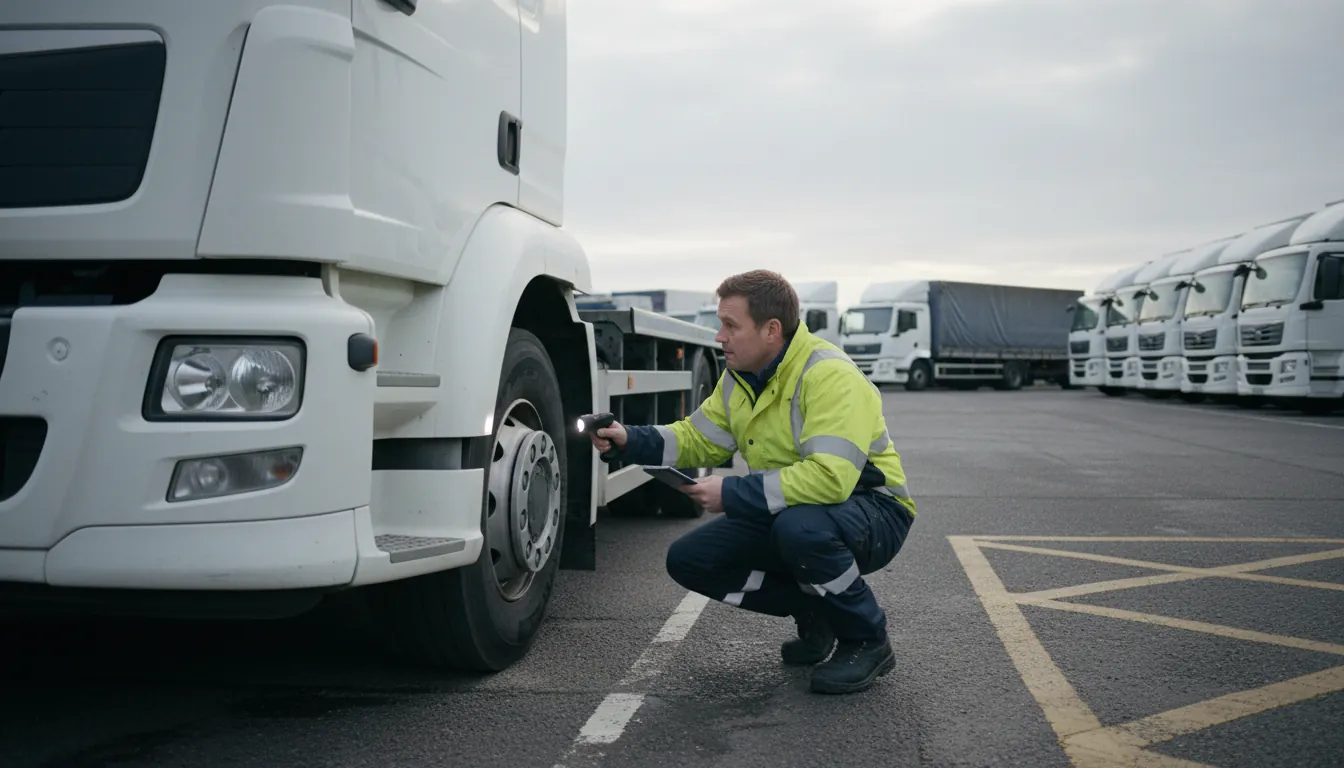
Complete, auditable inspection and defect records show that vehicles are maintained to a standard, not just repaired when they fail.
The evidence underwriters want to see
This is what commercial fleet underwriters and brokers typically look for. Each item needs to be current, consistent and backed by records.
- Accreditation. FORS or equivalent accreditation, DVSA Earned Recognition, or ISO 9001 certification, with the certificate and latest audit result.
- A documented licence check policy. Regular checks against DVLA data, with a frequency based on risk and a clear process for points and disqualifications. FORS, for example, expects HGV and PCV drivers to be checked at least every three months.
- Tachograph analysis and driver monitoring. Evidence that hours, speed and driving style are monitored and acted on, not just recorded. Debrief and coaching records carry extra weight.
- Preventive maintenance. A safety inspection programme at intervals set in line with DVSA's Guide to Maintaining Roadworthiness, typically every 4 to 13 weeks, with evidence that defects are cleared and that laden brake performance is assessed at every inspection, as DVSA has expected since April 2025.
- Walkaround and defect reporting. Daily checks, recorded defects and named sign-off before vehicles return to service.
- Accident investigation. A formal process for investigating and recording every incident, including near misses, with corrective actions documented.
- Driver assessment and induction. Assessments on recruitment and at intervals, with supervision linked to the risk rating, and inductions that include agency drivers.
- Health and safety risk assessments. Current, site-specific assessments covering vehicle movements, loading, tail lift use and manual handling.
- Claims history and corrective actions. A clear account of past claims and what you changed afterwards. That is far more useful to a broker than unexplained history.
Driver risk in practice
Employers have a legal duty to manage work-related road risk. HSE's guidance on driving at work makes clear that the Health and Safety at Work etc. Act 1974 and the Management of Health and Safety at Work Regulations 1999 apply to driving as they do to any other work activity: assess the risks, put controls in place, and check they work. For a fleet that means looking at the driver, the vehicle and the journey.
In practice, underwriters respond best to a system they can follow from start to finish:
- Licence checks at a frequency based on risk. The FORS standard sets a useful benchmark: at least six-monthly for drivers with 0–5 points, quarterly for 6–8 points and monthly for 9 or more, and at least every three months for HGV and PCV drivers.
- A risk rating for each driver drawing on licence points, incidents, tachograph infringements and telematics data, with closer supervision for higher-rated drivers.
- Debriefs and coaching recorded and followed up, so you can show that a problem was spotted and dealt with.
- Driver CPC and refresher training tracked against expiry dates, with any additional training linked to the risks you have found.
Vehicle safety equipment and cameras
Safety equipment shows underwriters that you take vulnerable road users seriously. At FORS Bronze, requirement V6 expects HGVs to have side under-run protection on both sides and Class V and VI close-proximity mirrors, or an approved camera monitoring system. Cameras, proximity sensors and audible left-turn warnings are FORS Silver requirements under S6. Forward-facing and in-cab cameras are not legal requirements, but they can provide evidence when liability for a collision is disputed. If you fit them, your pack should explain how footage is kept, reviewed and used in driver coaching.
Beyond motor cover: the yard and the loading bay
Many of the most expensive transport claims happen off the road: a driver injured on a tail lift, a pallet dropped during unloading, a reversing incident in the yard. These sit with employer's and public liability rather than motor cover, and underwriters ask about them.
The evidence that helps is straightforward. Current risk assessments for yard movements, loading, reversing and manual handling. Tail lift thorough examinations under the Lifting Operations and Lifting Equipment Regulations 1998 (LOLER), at least every six months where people ride the platform, at least every 12 months otherwise, or at intervals set by a written examination scheme, with each report kept until the next one or for two years, whichever is later. Recorded tail lift training for every operator. An accident book and investigation records showing what changed after each incident. Our health and safety service builds these systems if they are missing.
Your OCRS and your public record
DVSA's Operator Compliance Risk Score (OCRS) rates roadworthiness and traffic compliance from roadside checks, prohibitions and offences. It is not an insurance rating, but it is objective evidence of how your fleet performs on the road. A green or improving score supports your case. A worsening score usually points to a weakness in maintenance or drivers' hours that an underwriter would want explained. We look at your OCRS as part of the gap audit and deal with what is driving it.
What operators get wrong
- Starting to think about evidence two weeks before renewal.
- Sending the broker policies with no records to show they are followed.
- Licence checks done once at recruitment and never again.
- Telematics installed but no record of any action taken on the data.
- Incidents settled through insurers but never investigated internally.
- Inspection intervals on the licence that the maintenance records do not match.
- Treating accreditation as a certificate on the wall rather than a system that runs all year.
What goes in your compliance evidence pack
We produce a clear, structured document your broker can put in front of underwriters. It typically includes:
- a summary of the operation: fleet, work, depots and management structure;
- accreditations and certificates, with the latest audit outcomes;
- driver management: licence check regime, assessment and induction process, training and Driver CPC tracking;
- monitoring: tachograph analysis, telematics use, debriefs and coaching;
- maintenance: inspection intervals, brake testing, defect clearance and recent performance;
- health and safety: policy, key risk assessments and accident investigation procedure;
- claims history with the corrective actions taken;
- improvements made since the last renewal, and what is planned next.
Everything in the pack is drawn from your own records. We do not overstate your position, because an underwriter who finds a gap between the pack and the reality will trust neither.
If your records sit in Roadworthy, our fleet compliance software, its compliance pack generation and weekly signed transport manager record make much of this evidence quick to pull together.
What has changed recently
- 31 December 2024: drivers on UK–EU international journeys must be able to produce 56 days of records, which is worth checking if you run international work.
- April 2025: DVSA's Guide to Maintaining Roadworthiness made a laden brake performance assessment part of every safety inspection. Brake test evidence is now a standard question in any maintenance review.
- 1 September 2026: FORS Standard v7.2 applies to audits, including fuel and AdBlue data by vehicle under O2.
- 16 September 2026: ISO 9001:2026 was published. Existing ISO 9001:2015 certificates remain valid until 30 September 2029.
When to start
The earlier the better. With several months before renewal, there is time to close gaps and build a record that shows the changes working. With less time, we focus on documenting what you already do well and fixing the quickest wins. If you have already renewed, start now for next year: every renewal can build on the last.
We work alongside your broker. We are not an insurer or a broker and we do not arrange cover. Our job is to give your broker better evidence to work with.
Sources and further reading
- Guide to maintaining roadworthiness (DVSA, GOV.UK)
- Operator Compliance Risk Score (GOV.UK)
- FORS Standard version 7 (FORS)
- FORS D1 Licensing (FORS)
- DVSA Earned Recognition IT system requirements (GOV.UK)
- Driving at work: managing work-related road safety, INDG382 (HSE)
Checked against the sources above on 5 October 2026.