Reviewed October 2026
Transport compliance calendar
Every key renewal, inspection interval and record-keeping deadline across a transport operation, in one place. Bookmark it.
FORS Accreditation
FORS Standard v7.2
- AnnualFORS re-accreditation audit
Bronze, Silver and Gold are renewed every year. Start preparing at least 8 weeks before the audit date. - AnnualSilver and Gold progression evidence
Silver and Gold need current performance data and evidence of continued improvement at each renewal. - AnnualFORS subscription
Banded by fleet size, from £40 + VAT for one vehicle to £2,350 + VAT for more than 100. The Bronze audit fee is £468 + VAT (£437 for 3 vehicles or fewer). - From 1 Sept 2026FORS Standard v7.2
All audits from 1 September 2026 are against v7.2. Record fuel and AdBlue by registration and calculate the diesel-to-AdBlue ratio (O2). - 12 / 24 monthsDriver professional development (D4)
Work-related road risk training within 12 months and counter-terrorism awareness training within 24 months, as set out in FORS D4. - OngoingStandard changes
Review your FORS documents whenever FORS publishes a new version or summary of changes.
Operator Licence
GV(LO)A 1995 · Traffic Commissioner
- OngoingFinancial standing
Standard licence: £8,000 for the first HGV and £4,500 for each additional HGV. Restricted: £3,100 and £1,700. Light goods vehicles only (standard international): £1,600 and £800. The money must be available for as long as you hold the licence. - 28 daysNotify changes to the Traffic Commissioner
Notify within 28 days of a change of transport manager, relevant convictions, the legal entity, the operating centre or the correspondence address. - As requiredVehicles within your authorisation
Never run more vehicles or trailers than your licence authorises, and keep the vehicles listed on your licence up to date. - OngoingLicence discs
Display a current operator licence disc in the windscreen (lower nearside) of every authorised vehicle. - OngoingOperating centre
Vehicles must normally be kept at an authorised operating centre when not in use. Changes need the Traffic Commissioner’s approval. - 9 weeks+New applications and variations
Allow at least 9 weeks. Applications with objections or queries take longer. - 5 yearsContinuation fee and checks
Licences run indefinitely, but the continuation fee and checks fall due every 5 years.
Vehicle Compliance
DVSA Guide to Maintaining Roadworthiness · April 2025
- 4–13 weeksSafety inspections (PMI)
Typically every 4 to 13 weeks, set by vehicle age, type and operating conditions. Never exceed the interval on your licence. For Earned Recognition, an inspection counts as on time if done before or during the ISO week it is due. - Every PMILaden brake performance assessment
Laden roller brake test, EBPMS report (trailers) or decelerometer at every safety inspection. Risk-assess and record if not laden. At least four laden brake tests a year without EBPMS, including the annual test. - AnnualAnnual test
Every HGV, and every trailer that is subject to annual testing, needs a valid annual test certificate. - DailyWalkaround check
At least once in every 24 hours the vehicle is in service. Defects are recorded, repaired and signed off by a named competent person before the vehicle is used. - 15 monthsInspection and defect records
Keep safety inspection records for at least 15 months and have them ready for DVSA or the Traffic Commissioner. - 3 monthsNil-defect walkaround reports
Good practice is to keep nil-defect reports for at least 3 months. - OngoingTyre age
Tyres aged 10 years or more must not be fitted to the front steered axles of HGVs, buses and coaches. Check date codes at every inspection.
Tachographs & Hours
Assimilated Regs 561/2006 & 165/2014 · RT(WT)R 2005
- 28 daysDriver card download
Download every driver card at least every 28 days, and when a driver leaves. - 90 daysVehicle unit download
Download at least every 90 days, and before the vehicle is sold or control passes to someone else. - RoadsideRecords drivers must produce
The current day plus the previous 28 days. On UK–EU international journeys, the previous 56 days. - 12 monthsTachograph data retention
Keep driver card and vehicle unit data for at least 12 months and be able to produce it on request. - 2 yearsWorking time records
Keep records under the Road Transport (Working Time) Regulations 2005 for 2 years. Average 48 hours a week over 17 weeks (extendable to 26), with a 60-hour maximum in any week. - 2 yearsTachograph inspection
Have each tachograph inspected and calibrated by an approved centre at least every 2 years. - From 1 July 2026Smart tachograph v2 for international vans
Vans over 2.5 tonnes on international hire or reward work need a version 2 smart tachograph and a standard international licence. - OngoingInfringement analysis
Review infringement reports, debrief drivers in writing and keep a record of the action taken.
Tail Lifts & LOLER
LOLER 1998 · PUWER 1998
- 6 monthsLOLER thorough examination
At least every 6 months where people ride the platform, at least every 12 months for goods-only lifts, or at the intervals set in a written examination scheme. - 2 yearsExamination report retention
Keep each report until the next one is made, or for 2 years, whichever is later (LOLER reg 11). FORS V1 also expects LOLER records within a 15-month maintenance history. - ImmediatelyAct on examination defects
Take any lift with a dangerous defect out of use. The examiner must report defects that pose an existing or imminent risk of serious injury to the enforcing authority. - DailyPre-use check
Operators check the safe working load plate, platform, controls and safety features before first use each day. This is good practice under PUWER and LOLER. - 3 yearsOperator refresher training
J&JL recommended practice. Refresh sooner after a new lift type, an incident or a long absence. - OngoingSafe working load
Make sure operators know that the load, pallet truck and operator together must stay within the SWL.
Driver Compliance
Licences · Driver CPC · Health · Drugs & alcohol
- Before first driveNew starter checks
Check the licence using DVLA data, the Driver CPC card and the tachograph card before any new or agency driver drives. - 3 monthsDVLA licence check
Risk-based. FORS D1: at least every 6 months for 0–5 points, every 3 months for 6–8 points and monthly for 9 or more. HGV and PCV drivers should be checked at least every 3 months. - 5 yearsDriver CPC periodic training
35 hours every 5 years. The expiry date is shown on the Driver Qualification Card (DQC). Driving without Driver CPC can lead to a fine of up to £1,000. - As requiredNational Driver CPC and returning drivers
National courses (from 3.5 hours) restrict a driver to UK-only work. Drivers lapsed 60 days to 2 years can return after a 7-hour course, then complete 28 hours within 12 months. - AnnualDriver health declaration
Annual declaration covering DVLA notifiable conditions, eyesight and medication (FORS D6). - 6 monthsEyesight checks
FORS D6 expects driver eyesight checks every six months. - AnnualDrugs and alcohol policy
Review the policy and re-brief drivers every year. Record the briefing.
Health & Safety
HSWA 1974 · MHSWR 1999 · RRFSO 2005
- AnnualH&S policy review
Written policy required with 5 or more employees, signed by a director. Revise as often as needed; we recommend at least annually. - AnnualRisk assessment review
Review annually and straight after any relevant incident or change in operations. Record significant findings with 5 or more employees. - AnnualFire risk assessment review
Regulatory Reform (Fire Safety) Order 2005. The assessment must be recorded in full (all businesses since 1 October 2023) and reviewed regularly and after any significant change. - AnnualCOSHH assessment review
Review annually and whenever substances or processes change. Diesel engine exhaust is an IARC Group 1 carcinogen. - 10 / 15 daysRIDDOR reporting
Deaths and specified injuries: notify HSE without delay and report within 10 days. Over-7-day injuries: report within 15 days. Most road collisions are not reportable, but loading and unloading accidents can be. Keep records for 3 years. - OngoingPPE
PPE at Work Regulations 1992 (as amended 2022). Duties cover limb (b) workers as well as employees. - AnnualYard and workplace transport review
Review traffic routes, reversing, coupling and loading bay arrangements (Workplace Regs 1992 reg 17; HSE HSG136).
ISO 9001 / Certifications
ISO 9001:2015 / 2026 · GDP · BRCGS
- 30 Sept 2029ISO 9001:2026 transition
ISO 9001:2026 was published on 16 September 2026. ISO 9001:2015 certificates must transition by 30 September 2029. From 31 March 2028, new certifications are to the 2026 edition only. - AnnualISO 9001 surveillance audit
Surveillance audits by your certification body in years 1 and 2 of the 3-year cycle. - 3 yearsISO 9001 recertification audit
Full recertification every 3 years. Start preparing 3 months ahead. - Planned intervalsInternal audit and management review
Run internal audits and management reviews at the intervals your quality system sets. We recommend at least once a year. - AnnualGDP Quality Agreement review
Review Quality Agreements with pharmaceutical clients at least annually and after any significant incident. Reference the Human Medicines Regulations 2012 and GDP Guidelines as applicable in GB. - AnnualFood transport certification audit
BRCGS Storage and Distribution (Issue 4) audits are annual; 2026 position statements apply from 10 August 2026. Check your certificate for the due date.
Roadworthy
Want these dates tracked for every vehicle and driver?
Roadworthy keeps inspections, MOTs, tacho cards, CPC and licence checks for the whole fleet and shows what’s due before it’s late.
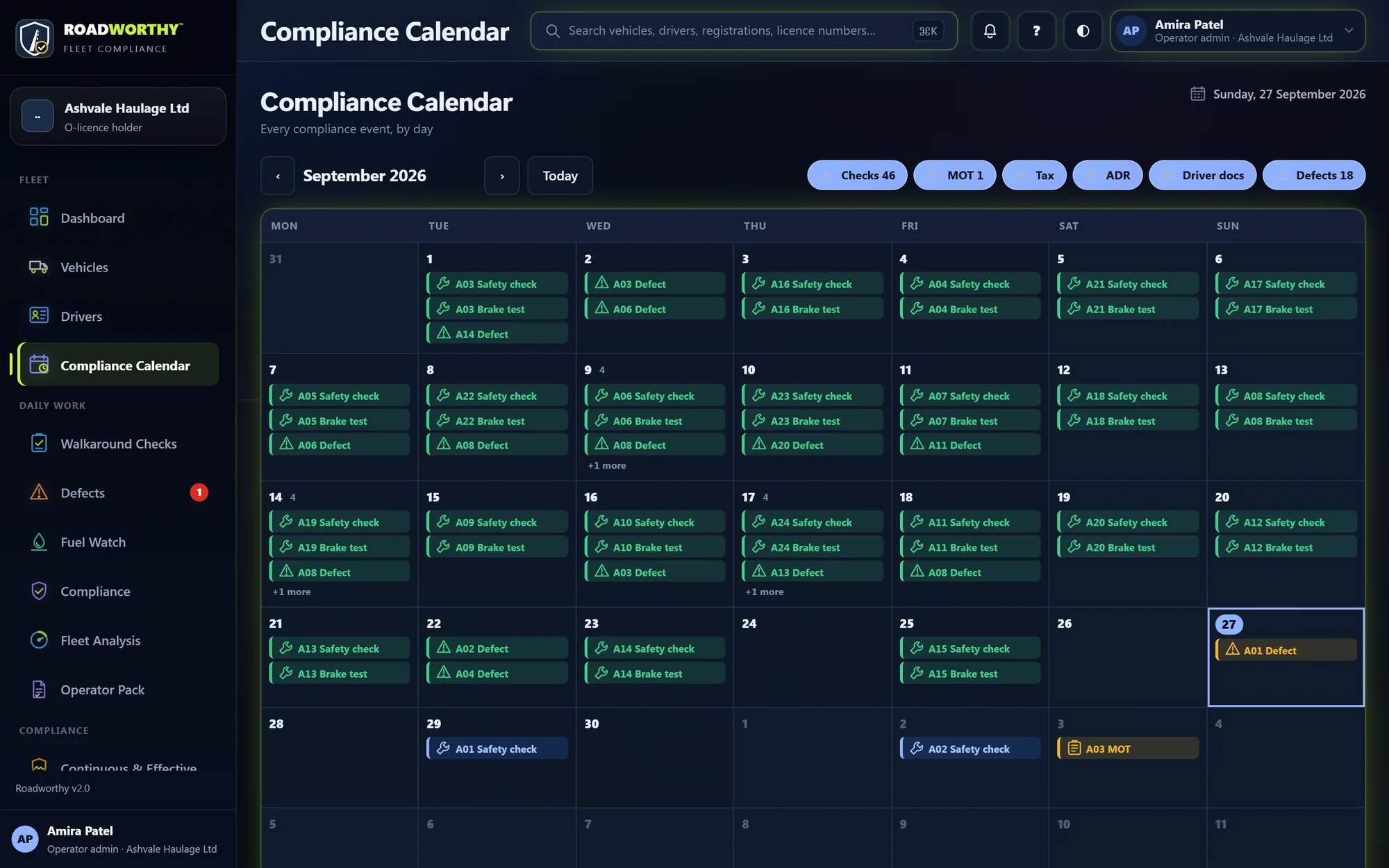 Visit Roadworthy Sample data
The real Roadworthy platform, running its demo operator. Click to visit roadworthyfleet.co.uk.
Need help managing all of this?
We can set up the systems and records behind every date on this page.