Update, 5 October 2026
We first published this guide on 5 April 2026. Since then diesel has fallen and risen again. The government's weekly figure for the week commencing 28 September 2026 was 197.58p a litre, and the RAC reported a record UK average of 200.01p on 2 October. On 20 May 2026 the government extended the 5p fuel duty cut to 31 December 2026 and gave HGVs a 12-month VED holiday. The figures, duty facts and FORS references below are updated. Unsourced price forecasts and savings percentages from the original version have been removed.
Where diesel prices stand
The Department for Energy Security and Net Zero publishes average UK pump prices every week. These are the diesel figures that matter for 2026 so far.
| Week commencing | UK average diesel (pence per litre) |
|---|---|
| 2 March 2026 | 142.15 |
| 6 April 2026 | 186.75 |
| 13 April 2026 | 192.14 |
| 13 July 2026 | 164.52 |
| 28 September 2026 | 197.58 |
The rise followed the start of the conflict involving Iran at the end of February 2026 and the disruption to shipping through the Strait of Hormuz. Our diesel price article explains the background. The point for this guide is simple: prices have moved by tens of pence in weeks, in both directions, and you cannot plan around them. You can plan around how much fuel you use.
Duty, VED and VAT: what has changed
- Fuel duty stays at 52.95p a litre until 31 December 2026, after the government extended the 5p cut on 20 May 2026. The House of Commons Library reports that duty is due to rise by 3p a litre from 1 January 2027 and that the government still plans to withdraw the full 5p cut by 1 March 2027. The Autumn Budget on 28 October 2026 may change this.
- HGV vehicle excise duty: HGVs renewing from 1 July 2026 pay £1 for 12 months. The government puts the saving at £600 for a typical heavy lorry and £912 for the largest vehicles. The HGV Road User Levy is still payable, so check what is due at each renewal.
- Red diesel duty was also cut until the end of 2026. That only helps entitled uses such as agriculture and rail freight. It cannot be used in road vehicles.
- VAT is 20% of the pump price. At 197.58p that is 32.93p a litre. VAT-registered businesses can normally reclaim VAT on fuel bought for business use, so your real cost is the price excluding VAT. Make sure every fuel purchase is captured on a VAT receipt or fuel card invoice.
Work out what fuel is really costing you
A simple rule: every 1p a litre on 1,000 litres a week is £10 a week, or £520 a year. Diesel rose by 55.43p a litre between the week of 2 March and the week of 28 September 2026. Excluding VAT that is 46.19p a litre.
| Diesel used per week | Extra cost per week (ex VAT) | Extra cost per year (ex VAT) |
|---|---|---|
| 500 litres | £230.96 | £12,010 |
| 1,000 litres | £461.92 | £24,020 |
| 5,000 litres | £2,309.58 | £120,098 |
Those figures compare the government's weekly averages for 2 March and 28 September 2026. Use your own fuel card data to get your exact figure. The same rule tells you what a saving is worth: cutting usage by 1% on 1,000 litres a week saves 10 litres a week, which at 164.65p excluding VAT is about £856 a year.
Ten actions that cut fuel use
None of these depend on the pump price. Most cost little or nothing. They are listed roughly in the order we would tackle them.
1. Measure fuel use by vehicle and by driver
You cannot manage what you do not measure. Pull fuel card, telematics or engine data and calculate miles per gallon or litres per 100 km for each vehicle, then for each driver in comparable vehicles on comparable work. The gap between your best and worst drivers on the same work is your coaching opportunity. If you hold FORS, version 7.2 (audits from 1 September 2026) requires fuel data by vehicle registration under requirement O2, including AdBlue where relevant and the diesel-to-AdBlue ratio. Missing the ratio earns a minor action point.
2. Set and enforce an idling policy
An engine idling in a queue or to run the cab heater burns fuel and moves nothing. Most telematics and engine management systems report idle time. Multiply idle hours by your engines' idle consumption and the price you pay to see the cost. Then write a policy: engines off when stationary unless there is an operational reason, with idle time reviewed with drivers. On a public road, leaving an engine running unnecessarily while stationary is also an offence under the Road Vehicles (Construction and Use) Regulations 1986, as Rule 123 of the Highway Code reminds drivers.
3. Get tyre pressures right, every day
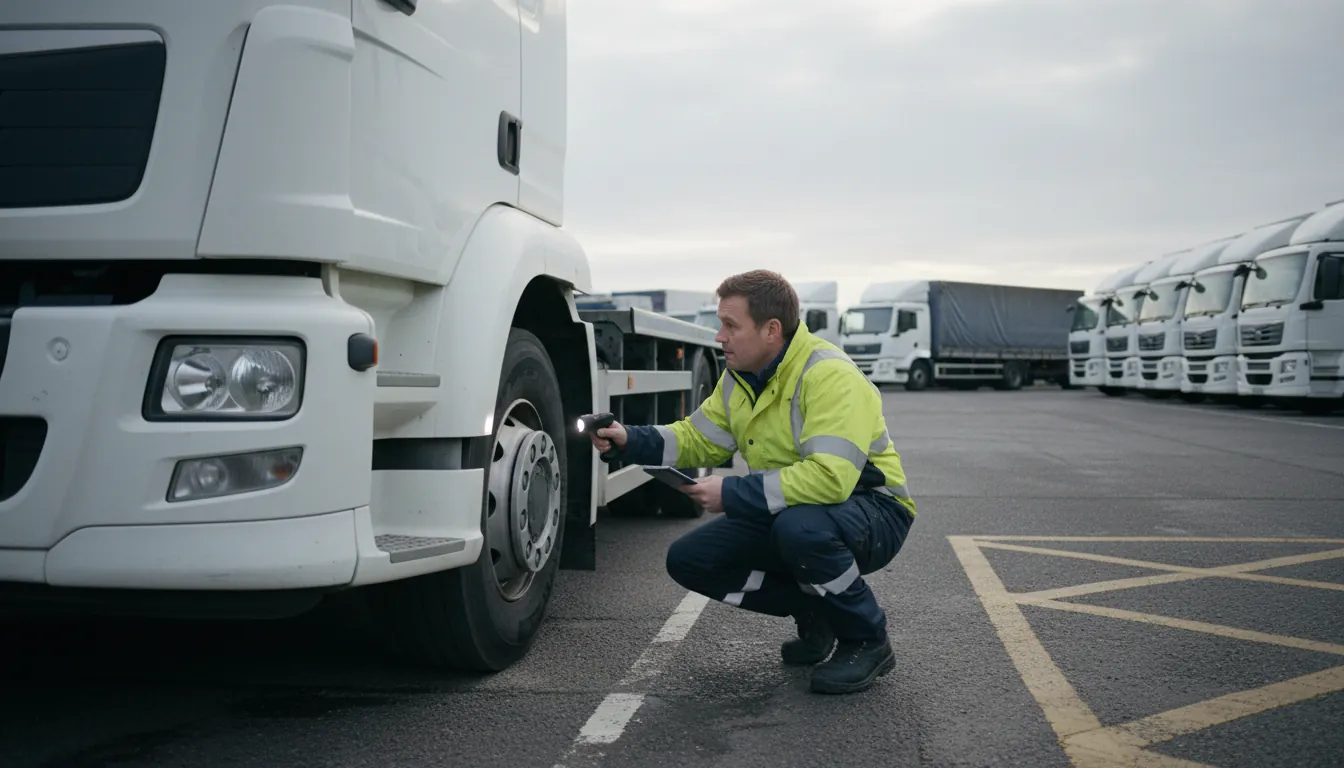
Under-inflated tyres increase rolling resistance and wear. Set pressures to the vehicle and tyre manufacturer's figures for the load, check them as part of the daily walkaround, and make low pressure a reportable defect. A proper tyre management system, which FORS also requires under V7, pays for itself in fuel and tyre life.
4. Coach drivers with their own data
Harsh acceleration, late braking, high cruising speeds and poor use of momentum all cost fuel. Generic "drive economically" briefings achieve little. Show each driver their own figures from last week, agree one or two things to change, and review the result. Recognise improvement. Keep a record of each coaching session so you can see what worked.
5. Manage speed
Air resistance rises sharply with speed, so the last few miles per hour cost the most fuel. HGV speed limiters are set at 90 km/h, about 56 mph. The legal motorway limit for HGVs over 7.5 tonnes is 60 mph, so for heavy vehicles the limiter, not the speed limit, is the effective cap. For vans and smaller vehicles, a company speed policy monitored through telematics does the same job.
6. Audit routes and empty running
Empty miles are the most expensive miles because they earn nothing. Compare actual mileage from tachograph or telematics data with planned routes and job data. Look for routes that can be combined, collections that could become backloads, and unnecessary trips back to base. Multi-drop and collection work usually shows the biggest gaps.
7. Fix the defects that burn fuel
Dragging or binding brakes, air leaks, poor wheel alignment, faulty injectors and EGR problems all push consumption up. Cross-check defect and inspection records against fuel figures vehicle by vehicle. A vehicle with outstanding defects and poor fuel figures is a priority on both counts. Brake tests at safety inspections are useful here too: our guide to laden brake testing at every safety inspection explains what DVSA now expects.
8. Control where and how fuel is bought
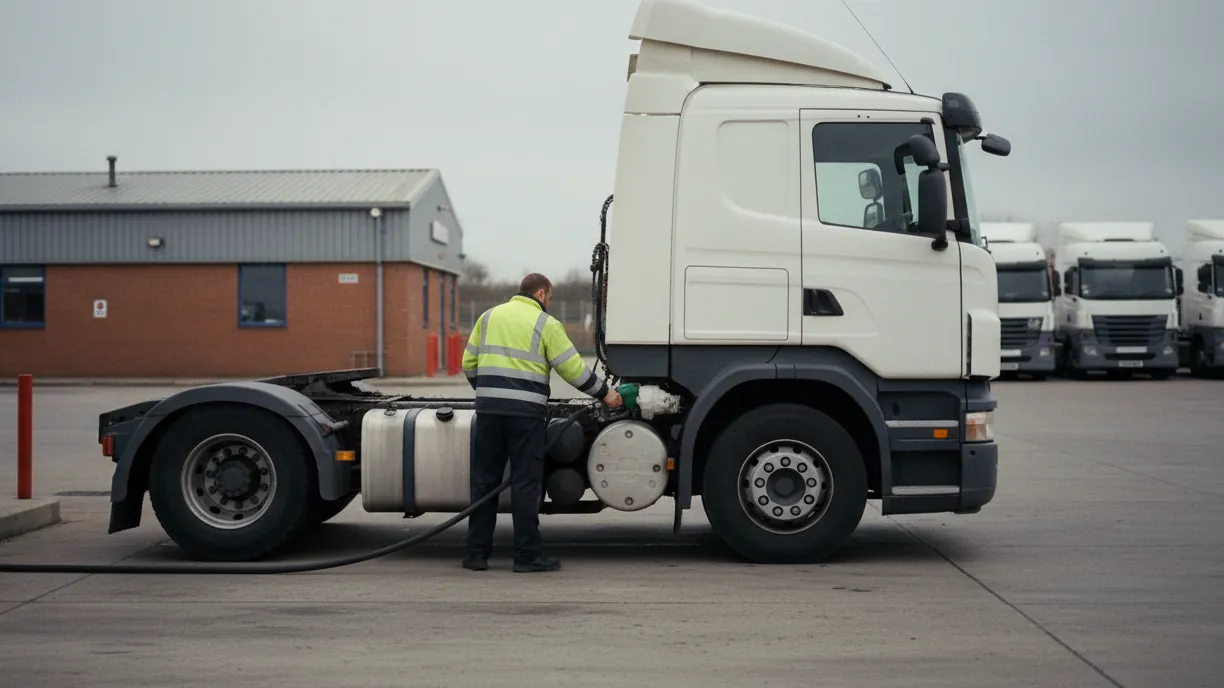
Without a fuel card or bunkering arrangement you have little data and less control. A fuel card gives you transaction-level records of who bought what, where and at what price, and flags anomalies such as fills larger than the tank. Motorway service prices are usually higher than other forecourts, so tell drivers where to fill and check that they do.
9. Treat AdBlue as part of fuel management
AdBlue is a running cost in its own right, and an unusual diesel-to-AdBlue ratio can point to an emissions system fault or tampering. Record AdBlue by vehicle alongside diesel. As well as meeting FORS O2, it gives your workshop an early warning. At FORS Silver and Gold, fuel and emissions data also feeds performance targets.
10. Commission a proper fuel audit
A review of fuel card spend tells you that you have a problem. An audit tells you where it is. It cross-references tachograph and telematics data, maintenance records, routes and fuel purchases vehicle by vehicle and driver by driver, then produces a prioritised action plan. That is what our fleet fuel cost reduction service does, in four stages: data review, maintenance audit, policy and process review, and an action plan with a driver briefing pack and a fuel KPI dashboard.
Where to start this week
- Check every tyre pressure on every vehicle, and add pressures to the walkaround check.
- Pull last month's idle time data and put a cost on it.
- Compare your best and worst drivers' fuel figures on similar work.
- Check your next HGV VED renewal dates and make sure the £1 rate and the levy are applied correctly.
How J&JL helps
We are former transport managers. Our fuel audit looks at your own data rather than industry averages and gives you a plan your planners and drivers can follow. Where tyre and defect follow-up is the weak point, Roadworthy, our fleet compliance software, handles daily walkaround checks by QR code on the driver's phone and tracks defects until they are closed. See Roadworthy fleet compliance software. Good compliance can also help with insurance costs.
Sources and further reading
- Weekly road fuel prices (DESNZ, GOV.UK)
- Chancellor protects drivers and businesses from rising fuel costs, 20 May 2026 (GOV.UK)
- Fuel duty: developments since 2022 (House of Commons Library)
- Speed limits (GOV.UK)
- The Highway Code, rules 103 to 158 (GOV.UK)
- FORS Standard version 7
- Diesel tops £2 a litre for first time ever, 2 October 2026 (RAC)
- Autumn Budget 2026 date (Which?)
Checked against the sources above on 5 October 2026.